 product
What matters, and how much
Design of experiments (Latin hypercube, Sobol, full factorial, D-optimal or your own list), sensitivity rankings, and a scatter study that measures each response's own noise before you trust a difference.

Crash is nonlinear, noisy and expensive. Naksha runs OpenRadioss studies on the model in your tree, runs them side by side, checks every run before it's trusted and holds every limit strictly.
For stiffness, stress and frequency, see structural optimisation.
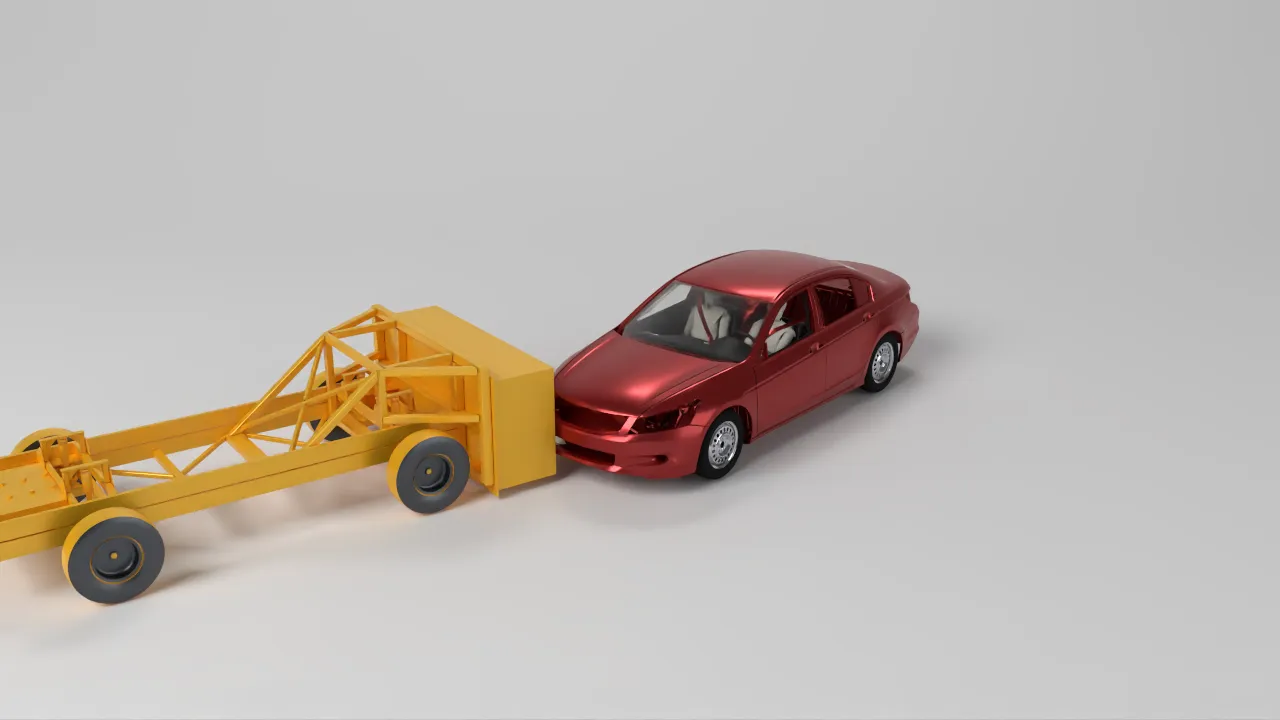
Crash optimisation has its own tab. Each study type starts from the crash model you already have.
Design of experiments (Latin hypercube, Sobol, full factorial, D-optimal or your own list), sensitivity rankings, and a scatter study that measures each response's own noise before you trust a difference.
The lightest wall thicknesses and material grades that meet your limits, from continuous ranges or the gauge list you stock. Mass is computed exactly, without a run. Apply design writes the result back into the model.
Solid topology on the real crash run, on bricks or tets: cut intrusion at the same mass, or let an intrusion limit drive the mass down. Manufacturing controls carry over.
A thickness for every shell element or every wall, so bending walls thicken and lightly loaded ones thin out, instead of one gauge for the whole section.
A Pareto front of mass against performance with every point run for real, a solution box of parameter ranges confirmed by runs inside it, and reliability checked by a Monte Carlo of real runs.
Place and size a set of bars or members over a region, for reinforcement layouts that a gauge study can't find.
A crash run can finish normally and still be wrong. Naksha grades every run before its numbers are used.
Run completion, OpenRadioss's energy error and an independent energy balance, hourglass energy, added mass, time-step collapse, impulse against momentum, work against energy, and impactor travel. Channels are filtered to SAE J211.
A design that misses a limit by any amount is infeasible. A tolerance is there if you want one, but it's off by default, so a reported optimum really meets every limit.
Crash responses scatter. A scatter study states each response's noise floor, and a scatter field shows where in the structure repeated runs part company.
The same studies run from the command line, or through Naksha's LLM link, which drives the tab's own buttons. Studies run on OpenRadioss today; LS-DYNA and Abaqus/Explicit as solvers are on the roadmap.
Every figure here is from real OpenRadioss runs through Naksha's crash studies, with each limit judged strictly.
| Case | Study | Result |
|---|---|---|
| 3-point bendSolid beam, half its mass | Topology, intrusion at equal mass | 23.45 → 12.66 mm on bricks; 21.47 → 11.27 mm on tets. With the default density representation, 11.81 mm, and 11.84 mm once made fully solid |
| 3-point bendIntrusion limit 16 mm | Topology, mass driven by the limit | 40.1% of the mass at 15.98 mm |
| Two impactsCentre and quarter hit | Topology over both load cases | Worst intrusion 15.99 mm, against 18.53 and 21.58 mm for designs tuned to either hit alone |
| Crush tube3 gauges, crush ≤ 70 mm, force ≤ 100 kN | Sizing, 21 runs | 256.0–262.6 g over three seeds, every limit met strictly |
| Crush tubePlus a frequency floor of 1.25 kHz | Sizing with Code_Aster | 286.6 g, crush 67.1 mm, first frequency 1.284 kHz |
| Crush railBead depth by morphing | Shape, minimum peak force | 48.90 → 36.99 kN (−24%); 4 candidate shapes refused by the element checks and never run |
| Ribbed sectionSix walls, intrusion limit | Thickness layout | 746.4 g, against 764.7 g for the best single gauge |
| Crush tubeMass against crush | Trade-off | 13 front points, every one verified by a run and feasible, from 188 g at 87.3 mm to 287 g at 66.1 mm |
| Crush tubeTolerance window for the gauges | Solution box | 13 of 16 confirmation runs inside the box meet every limit |
| Crush tubeGauge scatter, 10% failure target | Reliability | 2 of 20 real runs with scattered gauges fail: the target is met |
| Material calibrationHardening 1.20, friction 0.10 | Curve matching | Recovered as 1.204 and 0.101 |
Crash responses carry run-to-run noise, so small differences in mass near a limit can sit inside that noise. Naksha's scatter study states the noise floor for each case.
Send us an OpenRadioss model and its targets. We'll run a study and show you every run behind the answer.