 product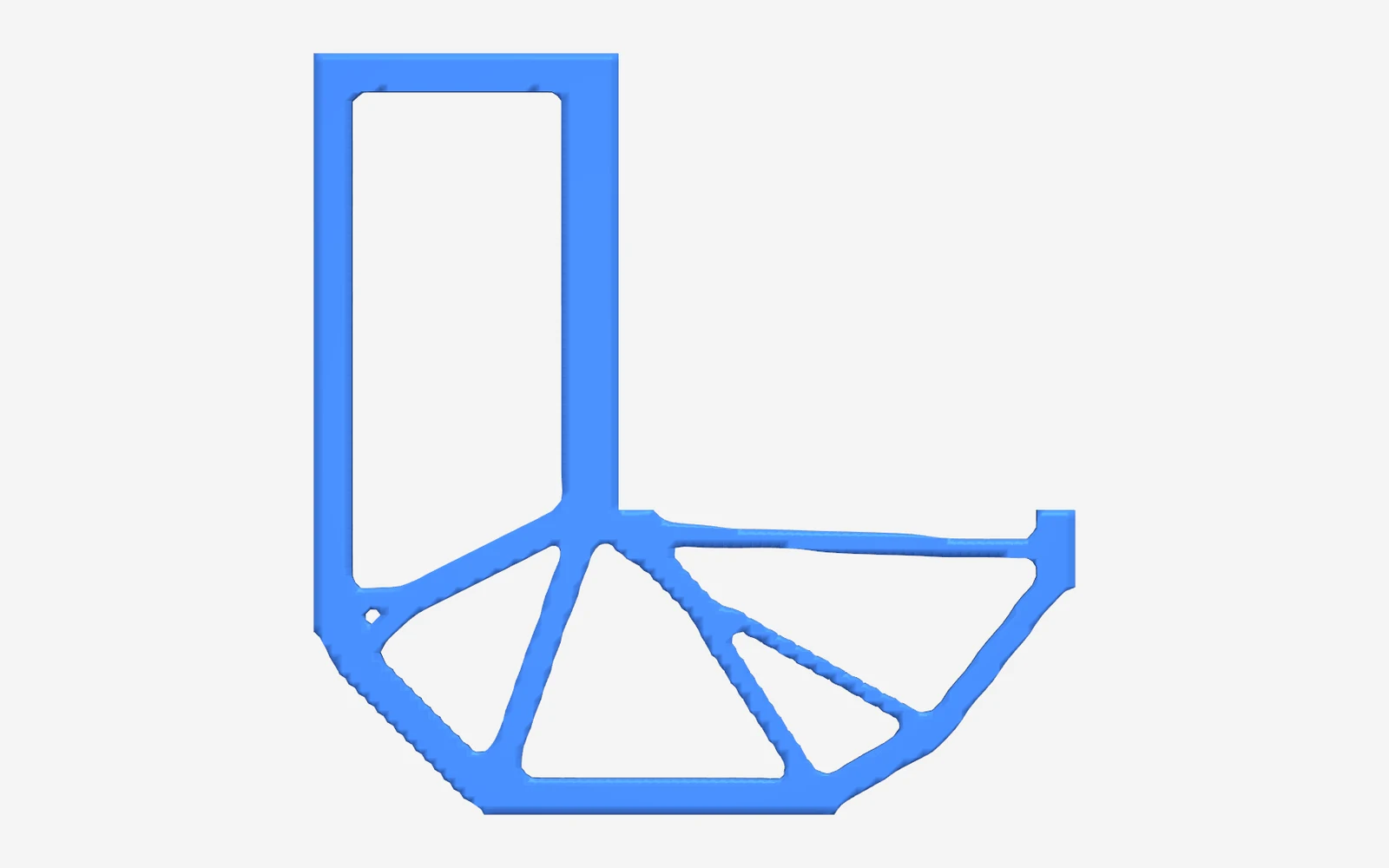
L-bracket
Minimum mass under a stress limit. The finished part peaks at 1.007× the limit, at the re-entrant corner, and a tighter limit costs material as it should.
Give Naksha a design space, the loads and the limits. It returns a lighter, stiffer part as a smooth, watertight surface, and checks it again as built before you see a number.
Topology and topography optimisation are included in Naksha Free.
Start from a block of design space. Naksha removes what doesn't carry load and keeps the paths that do, for the goal you set.
Minimum mass under a stress limit. The finished part peaks at 1.007× the limit, at the re-entrant corner, and a tighter limit costs material as it should.
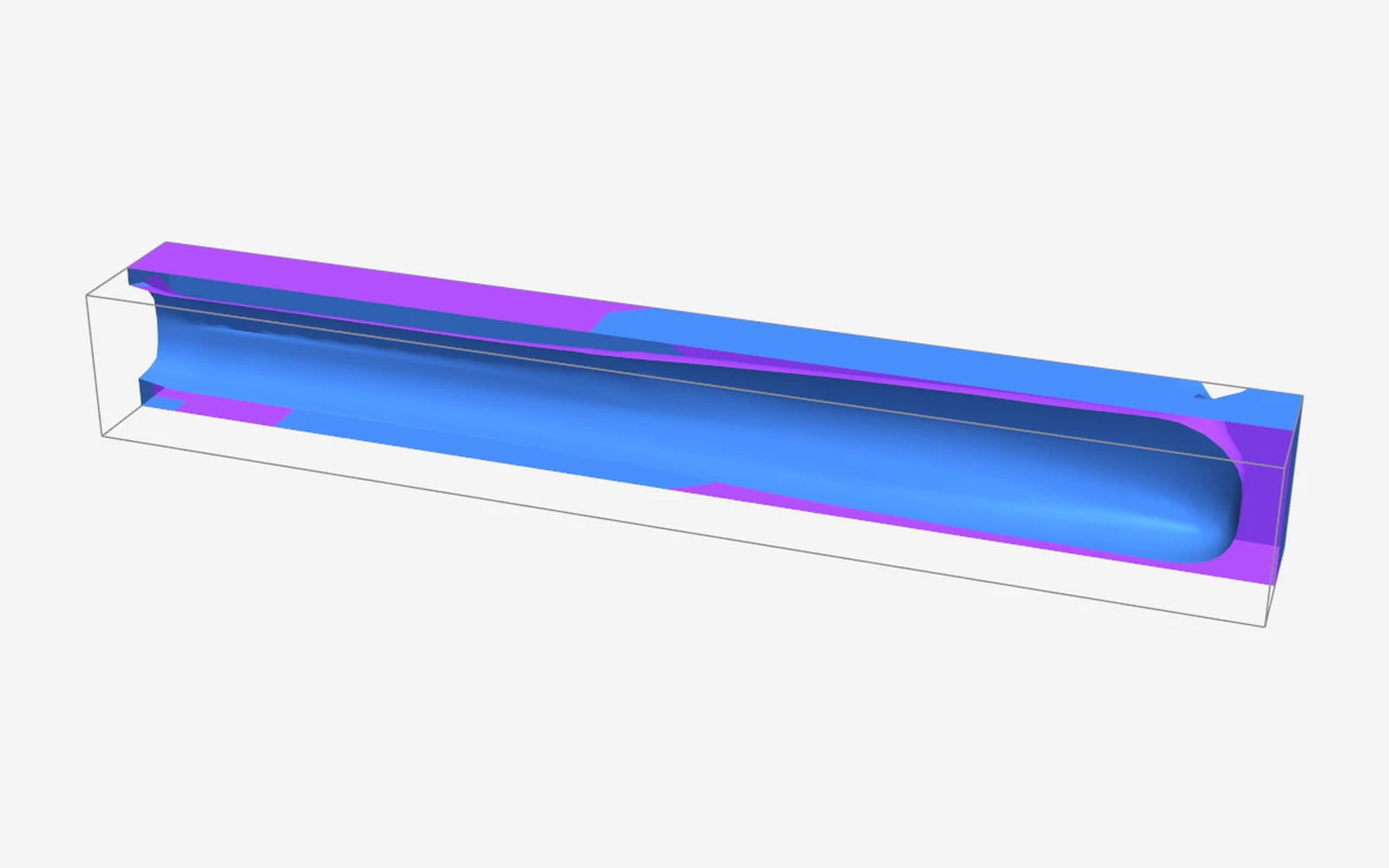
Half the material, buckling factor held at its bound. Material moves to the outside and the base: the core empties and the result is a tube.
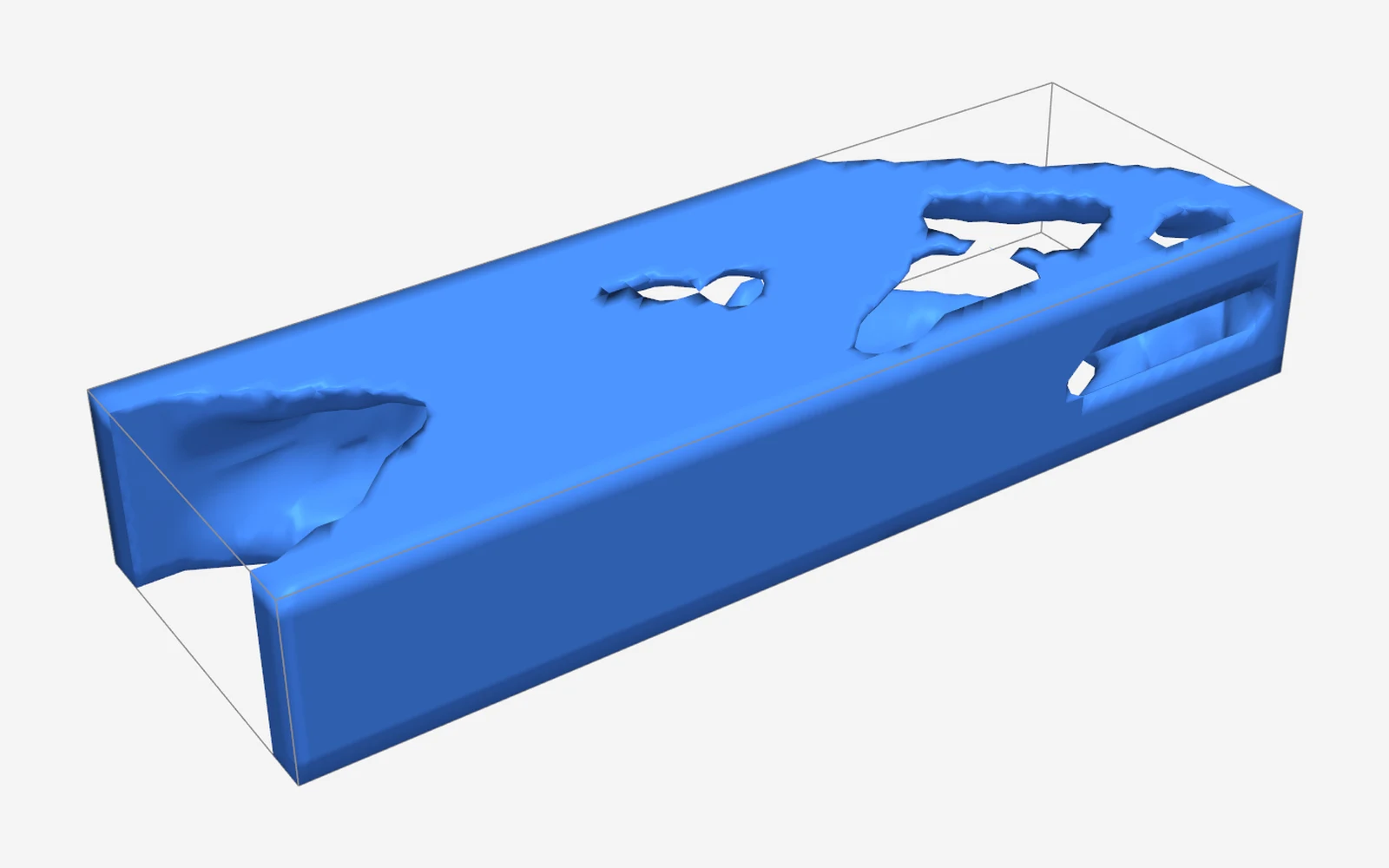
The two lowest frequencies are raised at a fixed mass. The part as built lands within 3–4% of the optimiser's prediction, so the gain is real, not grey material.
An optimised part is only useful if it can be cast, machined or printed. Naksha builds the process into the design, not into a clean-up afterwards.
Not every part starts as a block. For sheet and shell structures Naksha sizes the thickness, stamps beads and moves boundaries.
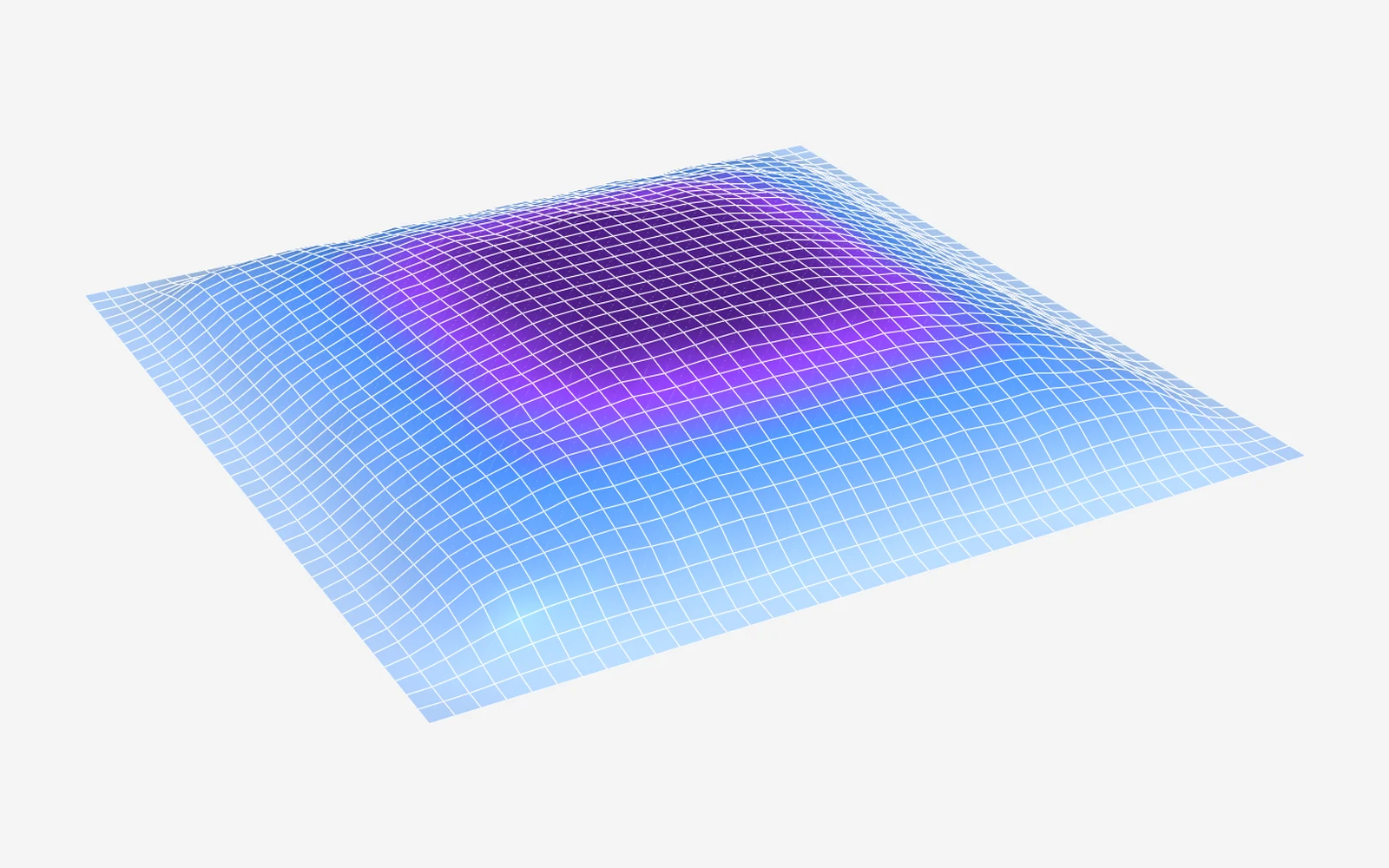
Beads stamped into a flat plate cut its compliance by 96%, about 24× stiffer, with no added mass. Bead height, draw angle and symmetry are under your control: the steepest flank is 16° against a 30° limit.
Free-size gives every shell element its own thickness. Here it follows beam theory to within 0.4%. Gauge sizing then snaps the result to standard sheet gauges, and the chosen set matches an exhaustive search of all 7,776 combinations.
Boundary nodes move to level the stress along an edge, with a mesh-quality guard on every step. On a plate with a hole the peak stress falls 8.9%. Under biaxial load, where a circle is already best, the shape is left alone.
Describe the changes you're willing to make, such as a moved rib or a wider flange, and Naksha finds the best combination of them.
Crash is nonlinear, noisy and expensive. Naksha runs the OpenRadioss simulations in parallel and checks every run before it's trusted.
An optimiser's own figures describe a cloud of partial material. Naksha turns the result into real geometry and solves that geometry again, so the number you report is the finished part's.
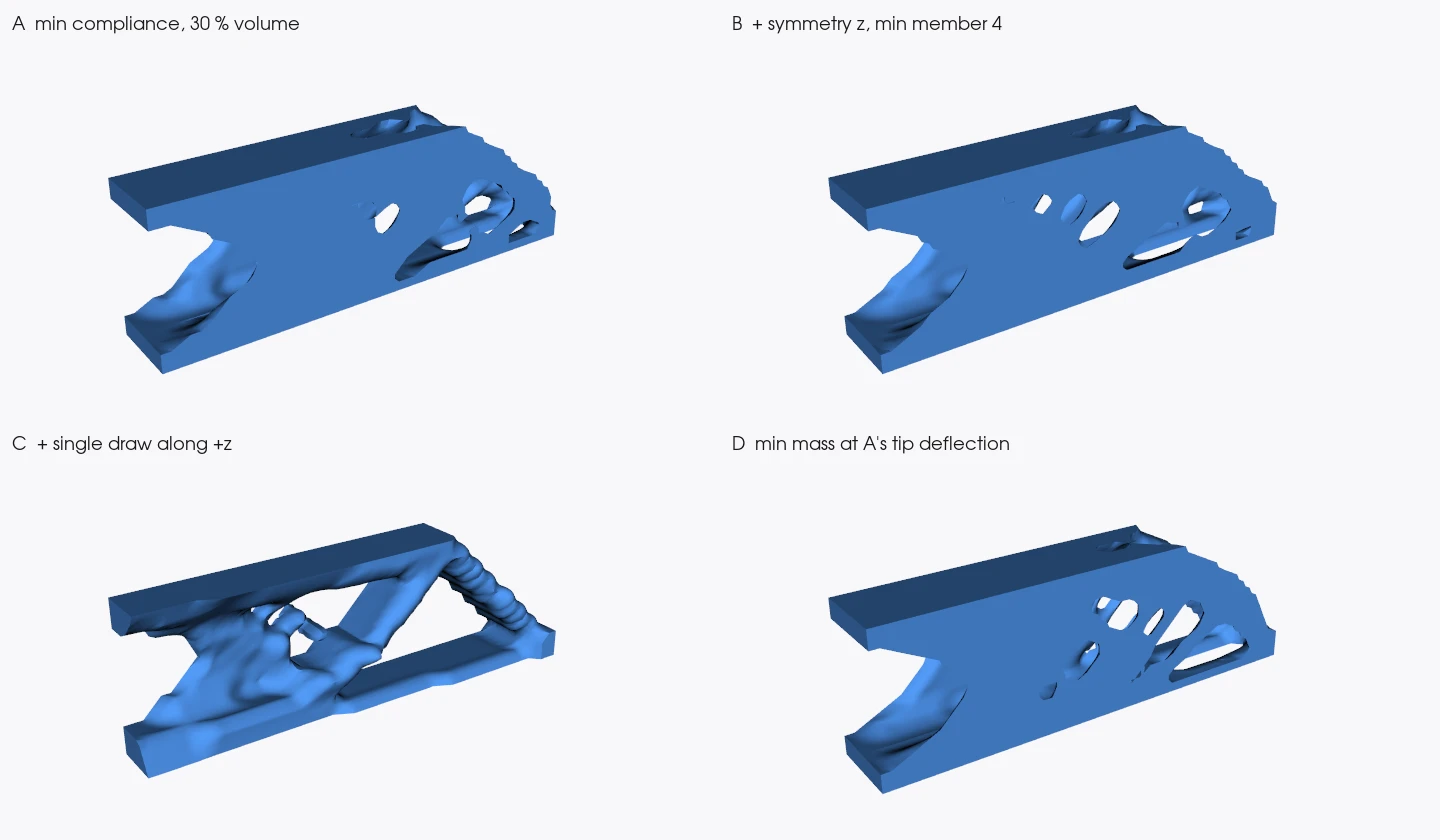
An example from the cantilever benchmark: the solid part on the optimiser's mesh agrees within 0.2%. On its own finer mesh, the part is 16% more flexible than the optimiser predicted, and that is the figure Naksha reports.
Each case has checks that can fail, and they print pass or fail. Here are the results, including the two that don't fully pass yet.
| Benchmark | What it checks | Result | Checks |
|---|---|---|---|
| CantileverStiffness at 30% volume, four variants | Exact symmetry, no undercut along the draw, as-built stiffness vs the optimiser | As built within 0.2%, symmetric to machine precision | 11 / 11 |
| L-bracketMinimum mass under a stress limit | As-built peak stress, no floating pieces, tighter limit costs mass | Peak 1.007× the limit | 5 / 5 |
| Clamped beamTwo lowest frequencies, 49–50% volume | As-built frequencies vs the optimiser, watertight surface | As built within 3–4% | 5 / 5 |
| ColumnTopology with a buckling bound | Bound met, material moves outward and to the base | Bound met at 49.6% volume | 5 / 5 |
| Bead plateTopography with draw angle and symmetry | Stiffness gain, slope limit, symmetry, bead discreteness | −96% compliance, 16° vs 30°; some beads stay part-height | 3 / 4 |
| Shell stripFree-size and gauge sizing | Thickness law vs beam theory, gauge set vs exhaustive search | Exponent 0.498 vs 0.5; the exhaustive optimum | Pass |
| Plate with a holeFree-shape | Peak stress, leaves an already optimal shape alone | −8.9% peak stress | 5 / 5 |
| 3-point bendCrash topology, OpenRadioss | Intrusion at equal mass; lightest design under an intrusion limit | 23.45 → 12.82 mm; 42% mass at 15.96 mm (limit 16) | 9 / 9 |
| Crush tubeGauge study, OpenRadioss | Lighter than the best sampled design, limits met, model accuracy | 271 g vs 298 g; predicted force 10.8% off at the optimum | 4 / 5 |
The optimisation engine also passes 20 of 20 internal tests, including every sensitivity checked against finite differences. The optimisation module is in active development and is being brought into the Naksha workbench. The results above come from the engine on our benchmark set. See the solver benchmarks →
Send us a part, its loads and its limits. We'll show you the optimised design and its as-built numbers.